Your company pays for a CRM, a project tool, a reporting add-on and a handful of apps someone signed up for last year. Each one does about 70% of what your team needs. The other 30% lives in spreadsheets, exports and the heads of two people who can't go on holiday at the same time.
For years, the answer was to live with it, because custom software was slow, expensive and risky. That has changed. AI has made building software faster and cheaper than at any point we have seen. But it hasn't changed the hardest part of the job: deciding what to build.
The short answer: Off-the-shelf software is still the right choice for standard work like email, accounting or payroll. For the workflows that make your business different, custom software now usually makes more sense than it did five years ago, because AI has significantly cut the cost of building. The real risk has moved from building to deciding what to build.
Below, we compare the four realistic options, off-the-shelf SaaS, an internal team, vibe coding and a software partner, and explain how to choose.
Why is now the best time to build custom software?
Three things changed at once.
Building got faster. In February 2025, Andrej Karpathy coined the term "vibe coding" for describing what you want in plain language and letting AI write the code. Tools now let a non-developer produce a working prototype in an afternoon, and professional teams use AI to remove much of the repetitive work.
SaaS got more expensive. Zylo's 2025 SaaS Management Index, based on the companies it tracks, found that SaaS spend averaged $4,830 per employee, up 21.9% year over year, with companies of up to 500 people using an average of 152 apps. Two thirds of IT leaders reported unexpected charges from consumption-based or AI pricing.
The idea of SaaS itself is being questioned. Microsoft's CEO Satya Nadella argued on the BG2 podcast that many business applications are essentially databases with business logic on top, and that this logic will increasingly move into AI agents. You don't have to agree that "SaaS is dead" to see the direction: the value is shifting from generic features to how well software fits your processes and data.
Put together, the price of a tool built around your workflow has dropped, while the price of renting a generic one keeps rising.
Custom software vs off-the-shelf SaaS vs internal team vs vibe coding: how do they compare?
| Off-the-shelf SaaS | Internal team | Vibe coding | Software partner on a retainer | |
|---|---|---|---|---|
| Best for | Standard work every company does the same way | Companies whose product is software | Prototypes, internal experiments, marketing pages | Core workflows that make your business different |
| Time to start | Days | Months (hiring) | Hours | Weeks |
| Fit to your process | You adapt to the tool | High, once the team knows the business | Depends on the person prompting | High, once the team learns the business |
| Who decides what to build | The vendor's roadmap | Your team, if it has product experience | Whoever writes the prompt | Shared, with the partner bringing experience from other projects |
| Security, maintenance, scaling | Vendor | Your team | Often nobody | Partner, with clear handover rules |
| Main risk | Rising licences, workarounds, lock-in | Cost and slow hiring | Fragile code nobody understands | Choosing a partner who builds without understanding |
When is off-the-shelf software still the right choice?
Buy when the work is the same in every company. Accounting, payroll, email and video calls are good examples. A vendor spreads the cost of building, security and compliance across thousands of customers, and you won't beat that.
Off-the-shelf starts to fail when:
- Your team works around it. Exports, copy-paste between tools and side spreadsheets are a sign the tool doesn't fit the process.
- You pay for features nobody uses. Pendo's analysis of its customers' products found that 80% of features were rarely or never used. In a big suite, you pay for all of them.
- Several tools hold the same customer. Every extra system is another place where data can disagree.
- The way you work is your advantage. If a process is why clients choose you, making it look like everyone else's is a strange goal.
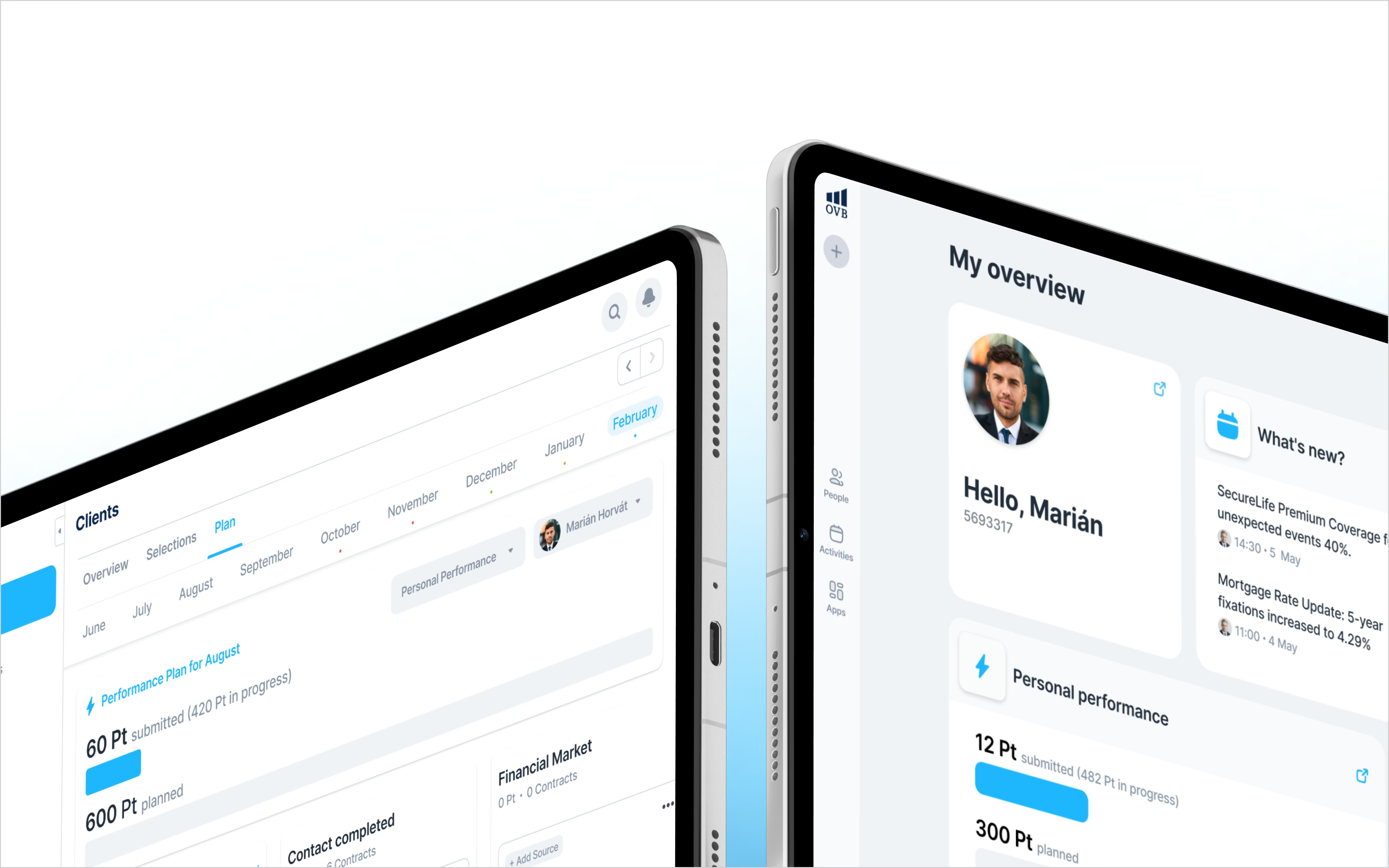
At OVB, advisers worked across older applications that weren't connected, so they duplicated work and new colleagues had to learn several systems. We built Aero, a custom CRM that brought five tools into one workspace. In a user survey, respondents reported a 20–30% improvement in work efficiency. That is a perception, not a measurement, but it shows how much daily friction a better fit removes.
Why not just hire an internal development team?
If software is your product, you will probably need your own team eventually. For most companies with 50 to 500 people, software supports the business rather than being the business, and an internal team is a slow and expensive way to get it.
- Hiring is hard. Eurostat found that 57.5% of EU enterprises that recruited or tried to recruit ICT specialists had difficulty filling those vacancies, rising above 70% in Germany and Czechia. The most common reason was a lack of applications.
- One developer isn't a team. Useful software needs product thinking, design, development, testing and someone who keeps it running. Hiring all of those for one or two internal systems rarely adds up.
- The workload is uneven. You need a lot of capacity while building and much less once a system is stable. Salaries don't follow that curve.
Can vibe coding replace a development team?
For some jobs, yes. A prototype to test an idea, a one-off internal tool, a marketing page: vibe coding is excellent for those, and we use it ourselves. Even Karpathy described it as "not too bad for throwaway weekend projects".
It becomes risky when the software touches customer data, money or daily operations:
- Security. Veracode tested over 100 AI models on 80 coding tasks and found that, without security guidance, 45% of the generated code introduced a known security flaw. Its later October 2025 update showed the best newer models doing better, but still far from perfect.
- Production mistakes. In July 2025, SaaStr founder Jason Lemkin reported that an AI coding agent deleted his app's production database during a code freeze. The data was restored, and the vendor then separated development and production databases by default. The lesson is not that the tool is bad. It is that nobody had set the basic rules an experienced team would.
- Speed is not the same as progress. In METR's randomised trial in early 2025, experienced developers using AI tools on their own projects took 19% longer, while believing they had been 20% faster. METR has since said tools have improved and the result is out of date. The gap between how fast it feels and how fast it is remains worth remembering.
Vibe coding makes building cheap. It doesn't tell you what is worth building, and it doesn't maintain what you built.
This is the part most companies miss: vibe coding doesn't remove the need for a team. Someone still has to think through the design and how people will use the software, know how it should be built, test it, and keep it secure and running. That takes people with design thinking and development experience, and as the hiring figures above show, they are hard to find. The alternative to hiring them is a subscription. Software partners, including us, offer subscription-based development that starts at around €2,000 a month, which is less than it costs to hire and pay an internal team.
What is the hardest part of building custom software?
Deciding what to build. That was true before AI, and it matters more now that building is cheaper, because it is easier than ever to build the wrong thing quickly.
Every company we meet arrives with a long list of features. The value comes from cutting it down. When we built a property management platform for a real estate team, deals were spread across spreadsheets, shared files and separate tools, and the wish list was long. We started by watching how the team actually handled deals and testing clickable wireframes with employees before designing anything in detail. That let us agree on a focused first release: a deal pipeline, connected property and client records, checklists for each stage and AI evaluations of each property. Everything else waited until the team had used the first version on real deals, and their feedback decided what came next.
Knowing what to leave out comes from having seen similar projects succeed and fail. That experience is the part AI can't generate for you.
How do you decide whether to build or buy software?
Ask these questions about each workflow, in this order:
- Is this work the same in every company? If yes, buy.
- Is there a tool that fits at least 80% without workarounds? If yes, buy and configure it.
- Does this process differ from competitors or affect how clients choose you? If yes, building becomes worth considering.
- Can you measure what it costs today? Time per case, errors, waiting time, licences. Without a baseline you can't judge any option. Our guide to choosing which workflow to automate first helps here.
- Who will decide what goes into the first version? Someone needs both business understanding and product experience.
- Who will own it after launch? Security, updates, new requirements and support don't stop at release.
- Will people actually use it? A new system only pays off when the old way of working disappears. See A new system only pays off when people use it.
If you answered "build" for one or two important workflows, start there, not with a platform for everything.
What does good custom software look like in practice?
OVB's advisers had to prepare a separate protocol for every product a client considered, in an application that was slow and unstable. No off-the-shelf tool knew their 554 products, their approval rules or their existing systems. We built Multiprotokol, which combines products into one guided protocol, reuses client information and routes cases that need legal approval to the right people. OVB reported a 50% reduction in protocol preparation time, across more than 11,000 protocols a month.
The software matters, but most of the result came from understanding the process well enough to know what to simplify.
Your next step
List the five tools your team uses most and, next to each, the spreadsheet or export people use to fill its gaps. The tool with the longest list of workarounds is your best candidate for a build-vs-buy decision.
If you'd like a team that learns how your business works, helps you decide what is worth building and then builds it, without hiring an internal department, that is what we do at Outloud. Tell us which workflow your tools don't quite cover.
Sources
- Andrej Karpathy: “vibe coding” (2025)
- Zylo: 2025 SaaS Management Index
- Satya Nadella on the BG2 podcast (2024)
- Pendo: Feature Adoption Report (2019)
- Eurostat: ICT specialist hiring difficulties (2024 survey, 2023 data)
- Veracode: GenAI Code Security Report (2025)
- Veracode: October 2025 update
- The Register: Replit production database incident (2025)
- Replit: safer development and production databases (2025)
- METR: AI and experienced developer productivity (2025)
- METR: February 2026 update
- Outloud: Why most MVPs are too big, too slow and too expensive
- Outloud: custom real estate CRM
- Outloud: OVB Aero
- Outloud: OVB Multiprotokol