Helped BCB plan service around actual machine usage.
Black Control Box grew from a forklift distributor’s need to understand what was happening to its machines. Forklift servicing depends on operating hours, but checking those hours meant visiting each machine. Planning was scattered across different tools, and rented equipment could return damaged with little insight into how it had been used.
Over a two-year project, Outloud designed and built BCB Cloud for monitoring machines and organising maintenance, and BCB Kiosk for identifying operators and controlling access at the machine. We connected the software to custom hardware developed by a specialist partner, bringing equipment, operators and the service team into one connected system.
Gave the service team machine data it can act on.
BCB gained a shared view of machine usage, service needs and assigned work. Operating-hour readings can trigger maintenance tasks, technicians have a planned itinerary, and service records stay with the machine. Kiosk connects the person signing in to the hardware that enables the starter, giving fleet owners more control over who uses their equipment.
Our work covered discovery, product design, web and app development, hardware integration and launch materials. The result was a foundation for both BCB’s own service operation and a product it could offer to other businesses.
Made service planning less dependent on one person.
The client’s maintenance expertise was already there. The challenge was making it available across the team. Physical service records could be lost or left incomplete. Google Tasks, WhatsApp and accounting software each held part of the working picture. One person carried much of the knowledge needed to keep everything moving.
That became harder to manage as machines accumulated different amounts of wear. Two forklifts of the same age might need servicing at very different times. A calendar reminder alone could not capture the difference: the team needed actual usage alongside each model’s service requirements.
We mapped these decisions with the client and made the service manager’s daily work the starting point for the internal software. Machine information, upcoming work and technician assignments needed to support the same process. Recording that process in a shared system also made it less dependent on someone remembering a conversation or finding a paper record.
Turned service intervals into assigned work.
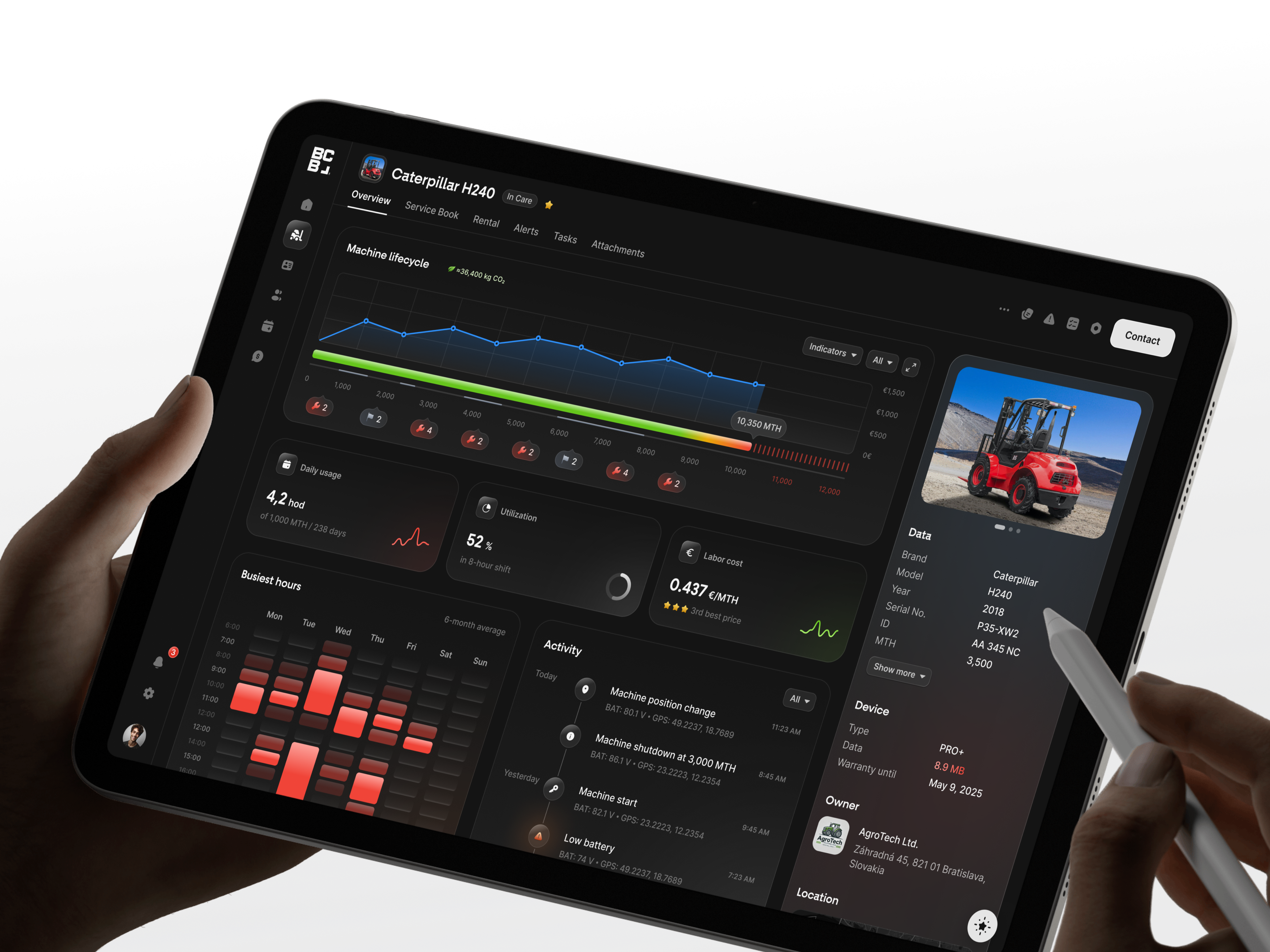
BCB Cloud connects the information needed to decide what requires attention with the tools to organise the work:
- Remote operating-hour readings. Check usage without visiting each machine just to read its counter.
- Maintenance tasks based on service intervals. Use model-specific requirements and recorded operating hours to determine when work is due.
- Assignments and progress tracking. Give the team a shared view of jobs and their movement through the service workflow.
- Technician itineraries. Connect scheduled work with routes and attendance tracking.
- A digital service logbook. Keep maintenance history available alongside the machine’s information.
- Maps and reporting. See where equipment is and explore how it is being used.
These features form a connected maintenance workflow. An operating-hour reading helps identify a service need; that need becomes a task that can be assigned and planned. The technician’s itinerary then supports attendance tracking and the service logbook. The team can move from understanding the machine to organising its next service within the same product.
This is where workflow automation makes the data useful. The service manager still organises the work, but the system brings upcoming needs into the planning process instead of relying on manual checks to discover them.
Brought routes and service priorities into the same planning view.
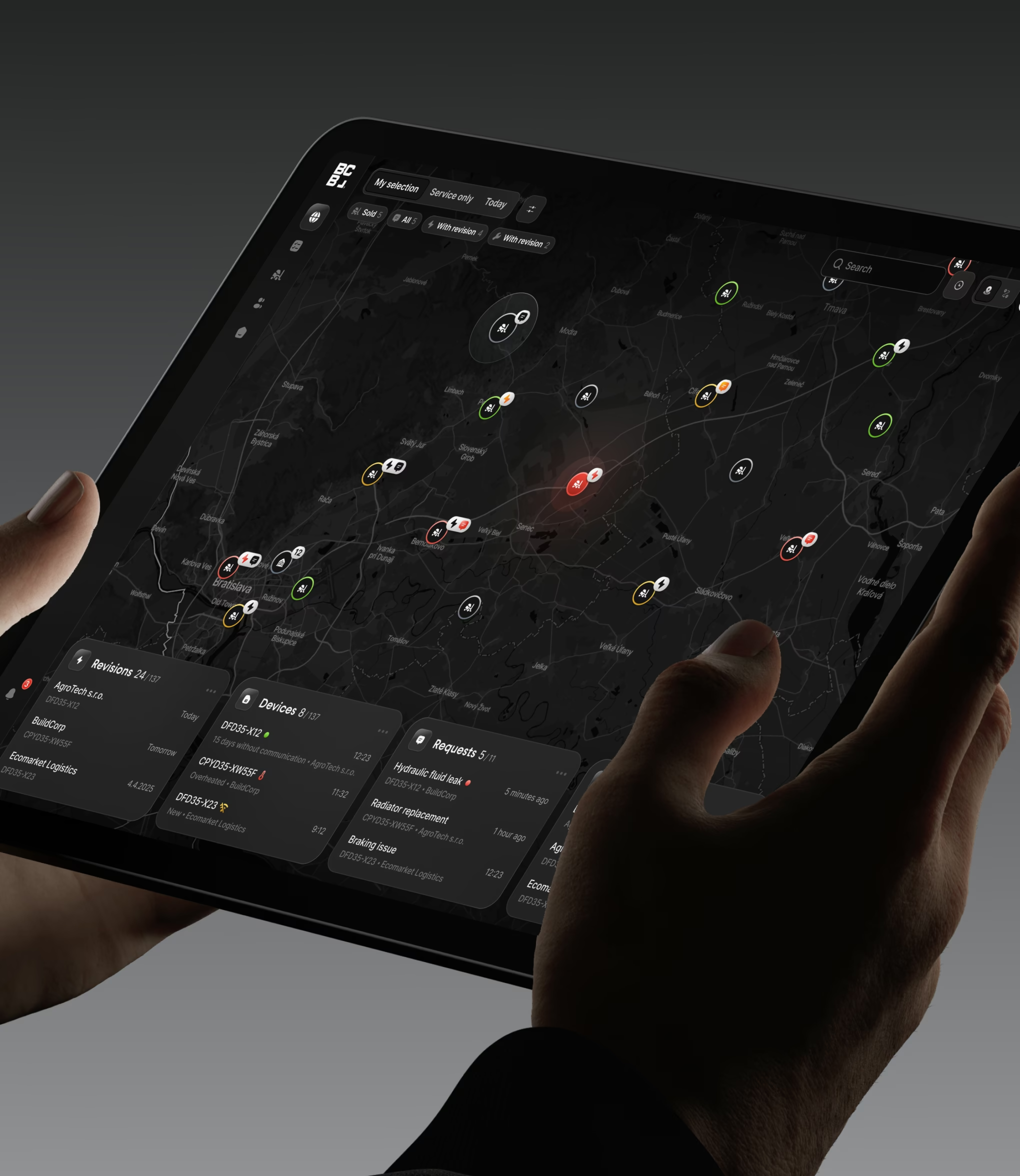
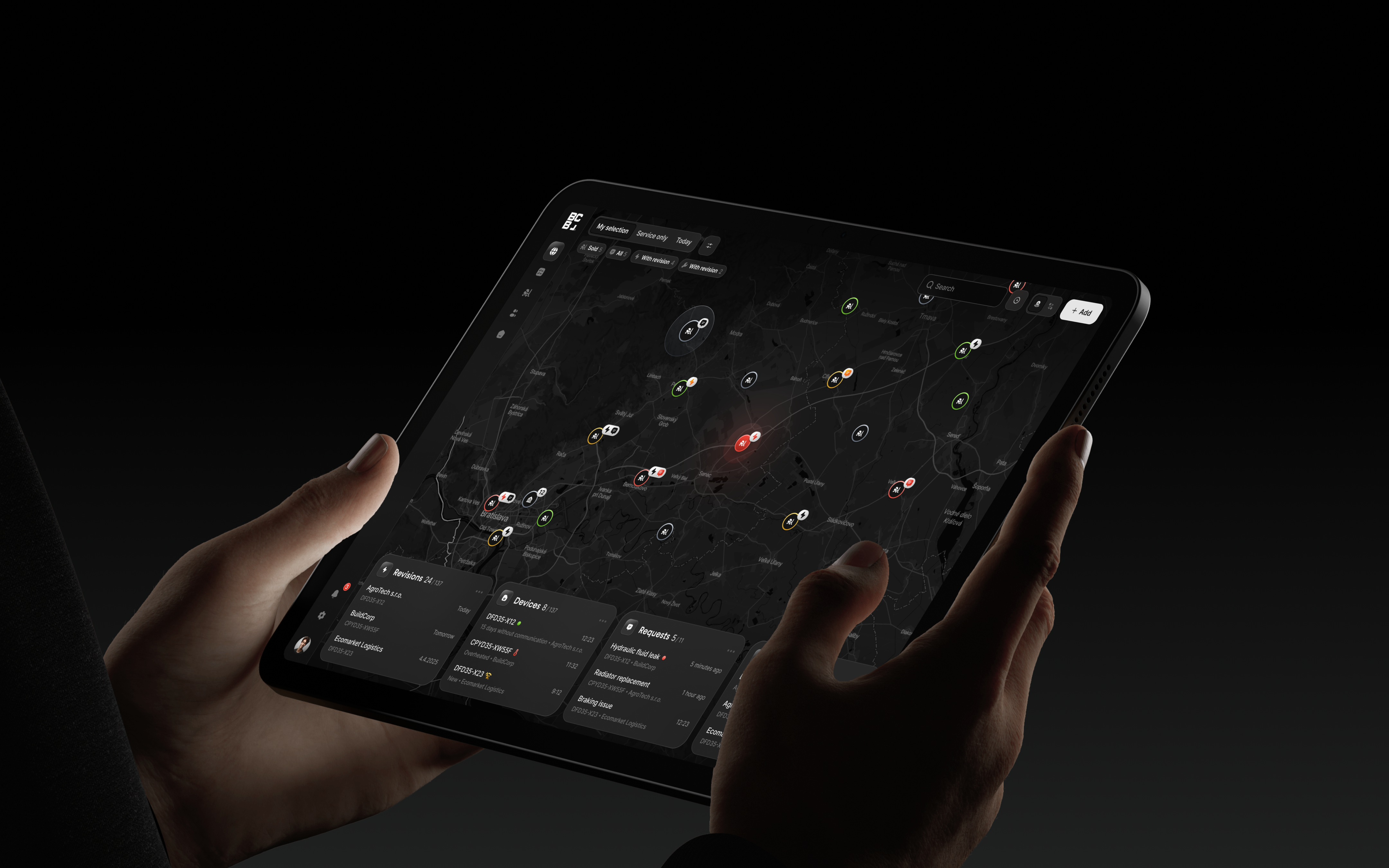
Knowing which machines need attention is only part of the job. The service manager also needs to organise visits across different locations. We made the map a central part of BCB Cloud, connecting the geographical view of the fleet with technician itineraries.
We evaluated mapping providers on cost, available features and how well they would fit the application. Mapbox provided the map layer, including AI-assisted navigation and route planning. This gave BCB routing support within the service-planning experience, alongside the jobs the team needed to complete.
AI has a specific role here. Maintenance tasks follow operating-hour readings and service intervals; the AI-assisted capability supports navigation and routing. The value comes from fitting each tool to the decision it helps people make.
Made a complex fleet easier to understand at a glance.
The Cloud interface needed to show rich information without overwhelming the people using it. We drew on the way strategy games combine interactive maps with modular panels: the map provides context while the surrounding controls make detailed information available.
High-fidelity wireframes were refined through workshops with the client, then developed into a design system. This gave machine records, planning tools and other parts of the platform a consistent visual language, so users did not have to learn a different interface for every task.
We also designed around access permissions. Different roles do not necessarily see the same information or controls, and those restrictions needed to leave a coherent screen. For users with limited experience of digital tools, clarity had to survive beyond the fully populated design mockup.
Kept machine readings available when connectivity drops.
The software depends on a physical device installed on each machine by the client. An external partner developed the hardware; Outloud worked closely with them on the communication between device and platform. This hardware integration had to account for conditions outside a reliable office network.
Devices store readings locally when mobile coverage drops and send them once connectivity returns. On the platform side, incoming data is validated and retried when processing fails. Records that cannot be handled automatically are flagged for manual review, so a difficult reading has a recovery path.
We used AWS IoT with MQTT to receive device messages, an AWS SQS queue to hold them for processing, and a Node.js processing layer. Separating receipt from processing means a temporary problem in one step does not have to interrupt the entire flow. The application uses AdonisJS and PostgreSQL behind a Nuxt web interface.
There were cost and location constraints too. Data travels over a mobile network, so we reduced message sizes and documented how hardware and software should exchange information. GPS can struggle inside covered halls; mobile-network positioning provides an approximate location as a fallback. It is less precise, but keeps location information useful when a GPS fix is unavailable.
Gave fleet owners control over who can start each machine.
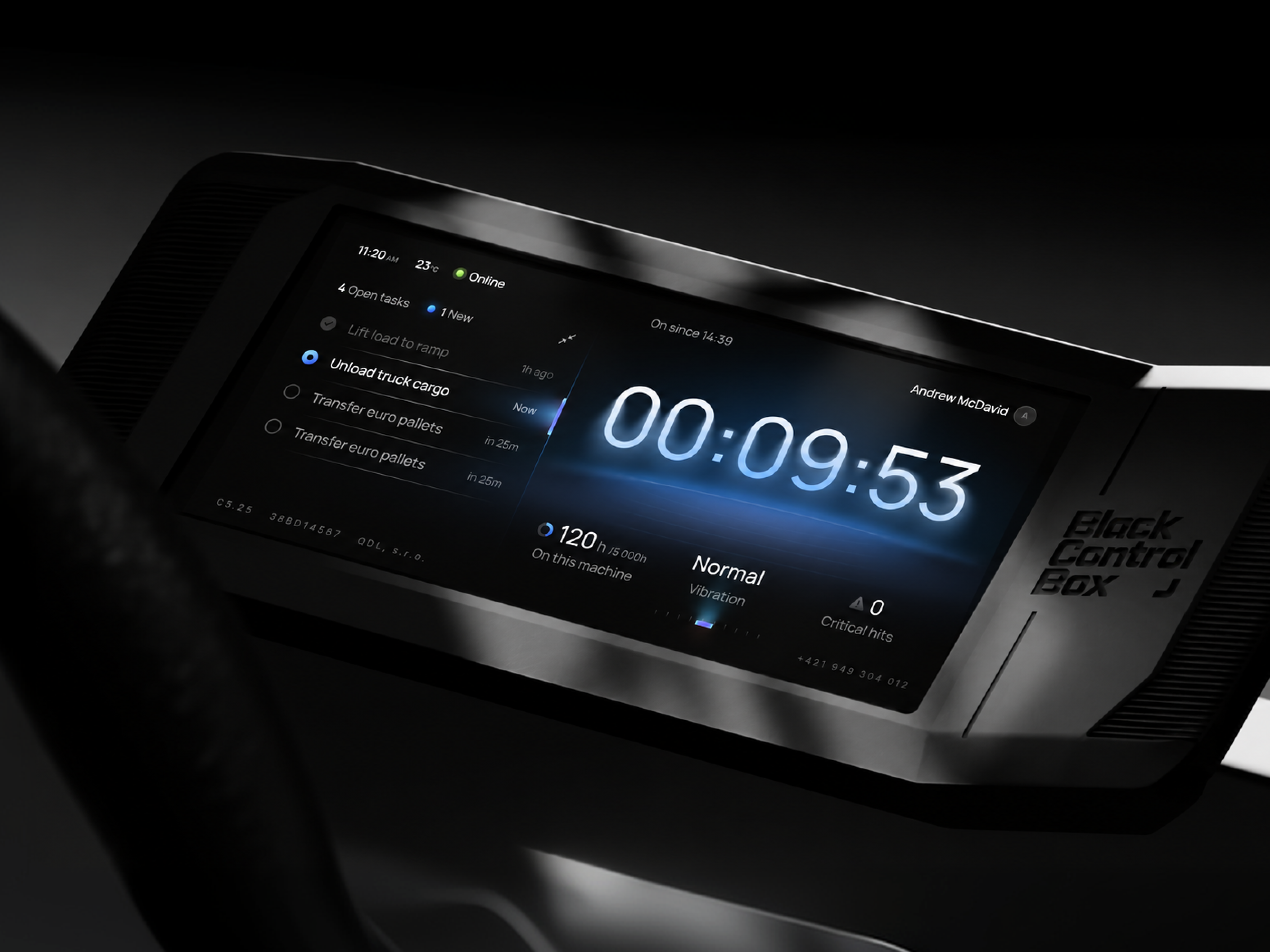
BCB Kiosk brings the connection to the operator. Running on the machine’s display, it links identification with access to the equipment. After successful authentication, the device sends a signal to the starter relay, enabling the machine to be started.
This makes access control part of the equipment itself. The platform also supports remotely disabling machine access when needed. For a business dealing with rented equipment and unclear responsibility for its condition, connecting use to an identified operator provides a stronger basis for accountability.
The display also gives operators working time, tasks, machine status and warnings at the point of use. Connected sensors provide additional operating information for the service team, while the operator sees what matters for the work in front of them.
Made warnings and daily tasks easier to follow at the machine.
Cloud and Kiosk serve different moments. A service manager may need to compare machines and plan a day’s work. An operator needs to sign in, see their next task or understand a warning quickly. Copying the management dashboard onto the machine would have created unnecessary complexity.
We designed a focused operator interface with clear working-time information, task lists and prominent warnings, including vibration alerts. Kiosk restrictions keep people inside the application instead of allowing them to switch into the underlying Android system.
This connects the office and the machine without giving both users the same screen. Fleet owners can manage access and review operating information; operators get a tool shaped around their immediate work.
Gave BCB a more maintainable app for its connected hardware.
We took over a partially developed Kiosk application from another supplier. Before building further, we compared the original specification with the existing Kotlin code. The audit established what was already present and what the intended product still required.
We rebuilt the application in Flutter to support consistent behaviour across supported devices and simplify future development. In parallel, we examined Android kiosk behaviour and the restrictions needed to keep operators inside the app. Device protection and the connection to the starter hardware were part of the application work, rather than separate concerns left until the end.
The rebuild gave BCB a clearer foundation to maintain. We documented core functionality, designed the operator flows and checked the hardware connection alongside the interface, keeping software behaviour and physical access aligned.
Helped BCB turn a broad concept into a usable product.
The initial requirements exceeded what could fit into the first delivery. We tackled the uncertainty in two parallel streams: a proof of concept validated readings travelling from devices to the backend and appearing on a map, while design workshops tested the shape of the service manager’s working tool.
As the project developed, service, sales, marketing and hardware stakeholders brought different priorities. We used frequent communication and ongoing prioritisation to keep those needs connected to a realistic roadmap. The first release needed enough of the operational workflow to be useful from day one.
That changed how we approached scope. For BCB, a useful first version required several parts to work together: device communication, machine information and service planning. Defining that connected scope was as important as deciding which individual features could wait.
Created a foundation BCB could offer to other businesses.
BCB was designed from the beginning with future licensing and customer branding in mind. We kept components modular and external services replaceable, so the platform could be adapted for different customers. That established a technical foundation for a broader product business alongside the distributor’s own service needs.
We also helped BCB explain and introduce the product. The design system extended into customer onboarding emails and landing pages, partner presentations, a showcase website and launch videos. These materials gave the client a consistent way to present the relationship between hardware, Cloud and Kiosk.
“Outloud helped us turn a complex telemetry concept into a market-ready product through strong collaboration and agile execution.”
Tomas Oslanec, CEO, Black Control Box
BCB shows what becomes possible when machine data is connected to the work around it. Usage informs maintenance, maintenance becomes planned work, and operator access is tied to the equipment. For companies facing similar gaps between their tools and operations, the starting point is identifying which information could make the next decision easier.
Explore the visual case studies for BCB Cloud and BCB Kiosk.